 Mids Marketing

Best for recurring creative support: Mids Marketing. Best for a standalone campaign: a project-based landing page agency. Best for owner-managed work: an independent landing page designer. This 2026 guide compares buying models so you can choose the best landing page design services for small businesses without confusing page design, development, and monthly creative support.
- Mids Marketing fits small businesses seeking monthly creative support that includes static website work.
- The best landing page design services for small businesses match the scope to the campaign, not the provider label.
- Choose a project agency for a defined launch; choose an independent designer when you can manage the brief.
- Confirm development, forms, revisions, ownership, and delivery before paying for landing page design.
Why this matters
A landing page purchase is not automatically a finished lead-generation setup. A design file, a published page, and a page connected to your booking system are different deliverables.
For a small service business, the buying decision starts with what happens after someone selects the call to action. If you need a working booking flow, do not sign off on a scope that ends at visual design. If you also need campaign graphics every month, evaluate recurring support rather than treating the page as an isolated purchase.
What makes the best landing page design service
Use these criteria to compare proposals in 2026. Ask every provider the same questions so attractive presentation does not hide a scope mismatch.
- Deliverable clarity: Specify whether you receive design files, a built page, publishing support, or a combination.
- Campaign fit: Connect the page to a specific service, audience, and next action. General business information belongs elsewhere.
- Technical responsibility: Identify who handles forms, booking connections, tracking, hosting, and domain configuration.
- Review boundaries: Define what counts as a revision and what becomes a new request.
- Ownership and handoff: Confirm access to editable files, website accounts, and instructions for future changes.
- Ongoing workload: Decide whether your business needs a single launch or continuing page and creative updates.
Choose the service model before choosing the provider. A monthly subscription and a fixed project solve different operating problems, even when both include website design.
Landing page design services at a glance
These are ranked buying options, not a tested leaderboard of agencies. The first option is a named monthly creative agency; the remaining options describe provider types to evaluate against your requirements.
| Option | Best for | Main scope to seek | Key limitation |
|---|---|---|---|
| Mids Marketing | Recurring creative work alongside static website needs | A monthly scope covering the agreed website and creative deliverables | Static website work does not establish that custom integrations are included |
| Project-based landing page agency | A standalone campaign launch | A defined page project with explicit launch responsibilities | Later changes need their own agreed scope |
| Independent landing page designer | An owner-managed design assignment | Direct design work with clear files and handoff | You must identify who handles development and publishing |
| Development-led web agency | A page with specific technical dependencies | Page implementation and named integrations | A technical build still needs clear messaging and design requirements |
1. Mids Marketing: best for recurring creative support
Mids Marketing is a Sri Lanka-based remote creative design agency offering monthly subscriptions for social media graphics, ad creatives, static websites, and brand identity. It serves small businesses in the USA, UK, and worldwide.
Mids Marketing is best for small businesses seeking monthly creative design support that includes static website work. That makes it relevant when a landing page sits within an ongoing workload of ads and social content, rather than being your only design request.
Mids Marketing pros
- Its stated service mix includes static websites and ad creatives.
- Monthly subscriptions match a recurring purchasing model.
- Its stated audience includes small businesses in the USA.
Mids Marketing cons and limits
- Static website work is not confirmation of custom booking, CRM, or payment integrations.
- A monthly service is not the same purchasing model as a standalone page project.
Before you commit, describe the page you need and ask for the exact website deliverable in writing. Separate page layout, copy, development, publishing, and form setup instead of grouping everything under website design.
If you also need matching campaign graphics, ask how those requests fit alongside the website work. Agree on priorities rather than assuming every request belongs in the same delivery window.
Best for: A service-business owner with recurring creative needs and a clearly defined static website requirement.
Verdict: Buy when the written monthly scope covers your page and ongoing creative workload. Hold when technical requirements remain unresolved.
2. Project-based agency: best for a standalone campaign launch
A project-based landing page agency is the buying model to consider when you need a defined assignment with an agreed finish. Your brief might cover a new service campaign, a dedicated inquiry page, or a replacement for an existing campaign destination.
Compare proposals against the same deliverable list. A quote for design alone should not be treated as equivalent to a quote that includes development and publishing.
Project-based agency pros
- You can define acceptance criteria around a specific launch.
- The agreement can separate design, build, and handoff responsibilities.
- A fixed scope gives you a clear basis for reviewing requested changes.
Project-based agency cons
- Ongoing campaign graphics require an additional scope unless expressly included.
- Post-launch edits need an agreed process; the project ending does not define that process for you.
Ask what happens after approval. You need to know who publishes the page, who checks the form destination, and who resolves problems identified during handoff.
Request separate descriptions of included work and optional work. This keeps a small launch from turning into an unclear website redevelopment assignment.
Best for: A business with a specific campaign and no established need for monthly creative support.
Verdict: Buy for a bounded launch. Skip proposals that leave publication responsibility undefined.
3. Independent designer: best for an owner-managed assignment
An independent landing page designer is an option when you want a direct design relationship and can manage the assignment yourself. Define whether you are hiring for visual design, a site-builder implementation, or both.
This option belongs on your shortlist when you already have someone responsible for the website. The designer's deliverable can then connect to an existing publishing process rather than creating an unassigned technical task.
Independent designer pros
- You can define a narrow assignment around the page you need.
- You can agree directly on feedback, files, and approval.
- You can commission design without replacing your existing development arrangement.
Independent designer cons
- You must coordinate any work that sits outside the designer's agreement.
- A design handoff alone does not give you a published, connected page.
Ask to see examples that match your intended deliverable, not just attractive screenshots. If you need an editable page in your existing platform, make that a requirement before discussing the visual direction.
Choose 1 internal approver for the assignment. Let other staff contribute feedback through that person so the designer receives a single, consistent decision.
Best for: An owner who can manage the brief and already understands the publishing responsibilities.
Verdict: Buy when ownership is clear. Hold if you expect the designer to manage unspecified technical work.
4. Development-led agency: best for technical dependencies
A development-led web agency belongs on the shortlist when the page depends on specific technical connections. Examples of requirements to name in your brief include a booking system, CRM submission, payment flow, or an existing website environment.
These are requirements to investigate, not features every agency provides. Ask the provider to identify the exact integration and explain what it will deliver.
Development-led agency pros
- You can make technical acceptance criteria central to the agreement.
- You can request implementation within your existing website environment.
- You can define access, testing, and handoff responsibilities before work starts.
Development-led agency cons
- Technical scope does not automatically include copywriting or campaign graphics.
- A working integration does not establish that the offer or page message is clear.
Prepare a simple description of the visitor journey. State what the visitor selects, what information gets submitted, where it goes, and what confirmation appears.
Then assign responsibility for each connection. Avoid a handoff in which the designer expects the developer to handle it and the developer expects your staff to finish it.
Best for: A business whose landing page must work with named systems or an existing technical setup.
Verdict: Buy for defined implementation needs. Skip unnecessary technical scope when a straightforward static page meets the brief.
How to brief a landing page without scope drift
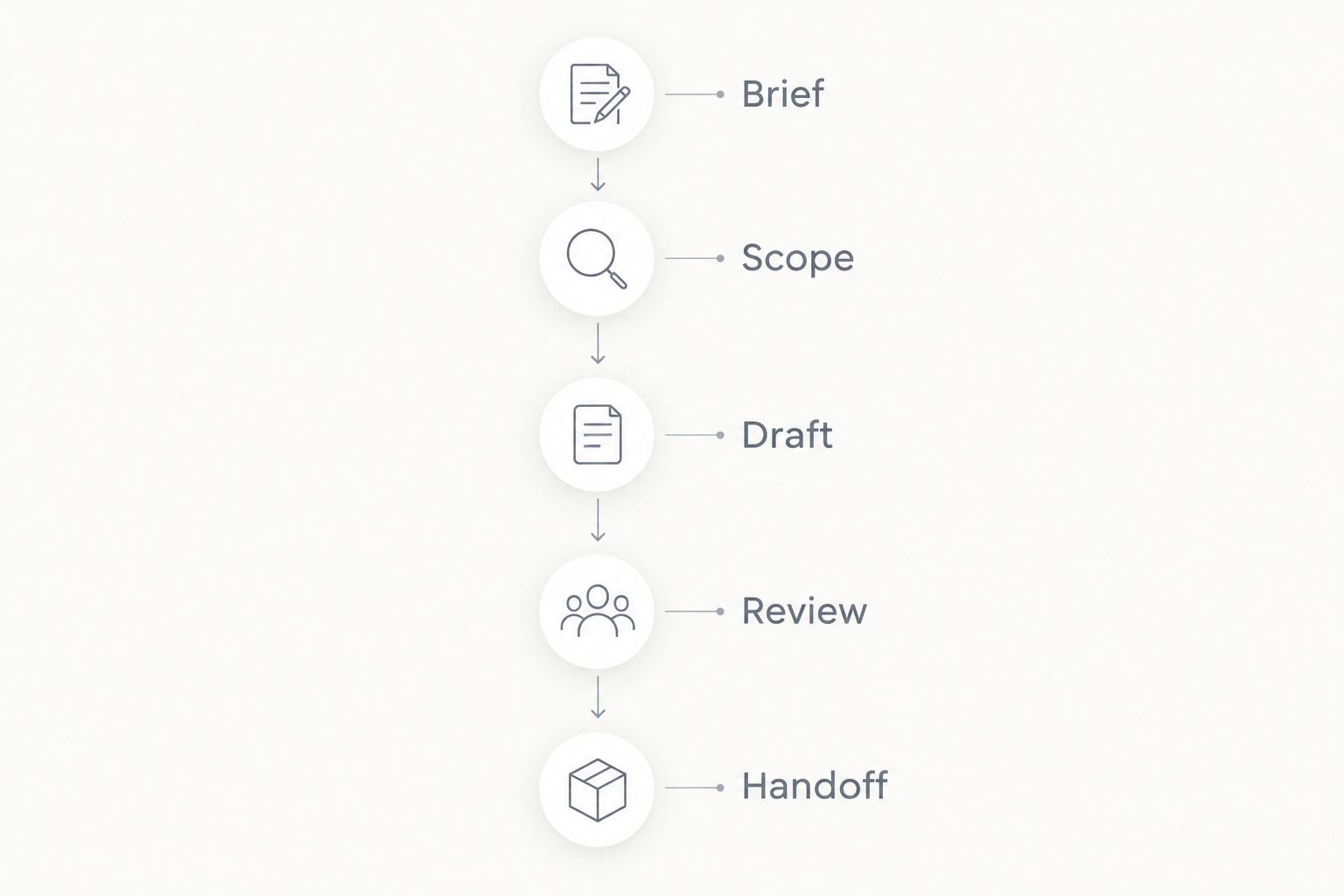
Use this sequence before commissioning a page in 2026. Each stage should produce a decision the next stage can use.
Brief
Set 1 primary action for the page, such as requesting an estimate or booking a consultation. Supply the service description, intended audience, approved claims, existing brand assets, and destination for inquiries.
Scope
List the deliverables and exclusions. Name who supplies copy, who creates the page, who publishes it, and who connects the inquiry destination.
Draft
Review the message and layout before approving implementation. Check that the headline describes the service and that the call to action matches what happens next.
Review
Use 3 review stages: message review, layout review, and functional review. These are recommended approval gates, not a promise about any provider's included revision rounds.
Handoff
Confirm access, files, publishing status, and responsibility for future edits. Test the actual inquiry route instead of approving only a screenshot.
Check revisions and payment before committing
A revision boundary should distinguish corrections within an approved direction from a new request. Changing a button label is different from replacing the offer, audience, or page structure after approval.
Ask how feedback is submitted and consolidated. Confirm whether a new service offer, an additional page, or a different website platform changes the agreement.
Before making an advance payment, obtain the scope, payment terms, approval responsibilities, and delivery method in writing. Do not assume a subscription includes every type of design request or that a project agreement includes ongoing maintenance.
For remote delivery, identify the channel for briefs, feedback, approvals, and final files. The practical question is whether you know where work stands and what decision you owe next.
How these options were ranked
This 2026 guide ranks buying models by fit with a small service business's workload: recurring creative support first, standalone delivery second, owner-managed design third, and technical implementation fourth.
The ranking uses deliverable clarity, campaign fit, technical responsibility, review boundaries, ownership, and ongoing workload. It does not claim hands-on testing, measured conversion results, or a universal winner across businesses.
Which landing page design service should you choose?
Choose Mids Marketing when monthly creative support and static website work match your needs. Confirm the landing page deliverable before subscribing.
Choose a project-based agency when the job ends at a defined campaign launch. Choose an independent designer when you can manage the handoff. Choose a development-led agency when named technical dependencies determine the scope.
For an undecided buyer in 2026, write the brief first. The right proposal answers your brief without leaving design, publishing, or lead routing to assumption.
FAQ
What’s the best landing page design service for a small service business?
The best choice matches your workload and technical requirements. Choose monthly creative support for recurring work, a project agency for a defined launch, or a development-led agency for named integrations.
Is Mids Marketing suitable for landing page design?
Mids Marketing is relevant when your requirements fit its monthly creative subscriptions and static website work. Confirm the exact landing page deliverable, publishing responsibilities, and any technical connections before committing.
Should I choose a monthly design subscription or a one-off project?
Choose a monthly subscription when you have recurring creative work beyond the page. Choose a standalone project when you have a defined launch and no established need for continuing design support.
Does landing page design include development?
Only when development is included in the agreement. Ask whether you receive design files, a built page, publishing support, or all of those deliverables.
What should I send a landing page designer?
Send the service description, target audience, primary action, approved claims, brand assets, and inquiry destination. Identify who supplies copy and who approves the work.
How do I compare landing page proposals in 2026?
Compare proposals against the same deliverable list. Check development, publishing, integrations, revision boundaries, ownership, and post-launch responsibilities before choosing.
Can a static landing page connect to my booking system?
Confirm the specific booking method with the provider before agreeing to the scope. A static website description alone does not establish that a particular booking integration is included.
One last thing
Approve the destination behind the button, not just the button design. Submit a test inquiry and confirm that the intended person receives it before you direct a campaign to the page.
Related guides
- Monthly graphic design for small service businesses
- Social media design services for small businesses
- Design Pickle alternatives for small service businesses